Thursday, August 22, 2013

Two steps forward, one step back: Our first year of homesteading

We're alive. 

We haven't managed to burn the place to the ground, or been accosted by marauding hillbillies a la "The Hills Have Eyes." Despite the barn cats' best efforts to trip me, my spine remains unbroken. No salmonella-tainted chicken eggs or diseased turkey meat have crashed the party; the raw goat milk the FDA craps themselves over regularly has yet to unleash its dark and sinister forces. So far so good, but we still have so very very much to learn. 

         When we started chasing this half-crazy little whimsy of ours into tangibility we knew we'd have to learn new skills. I read book after book and prided myself on my foresight, I practiced what I could and filed away the rest for later use. All of that has proved absolutely invaluable; but, at the same time, wasn't worth crap until we really got our hands dirty. 

      I've learned that metal pole barns turn into giant freezers in cold weather, and that even a pump with a heating element will freeze when it's -5•F. At that temperature sweat likes to ice up on your face while hauling 5 gallon buckets of hot water, which is especially fun if you require glasses.

       Pregnant goats are on their own clock, and the more one tries to decipher their mysteries the later they will carry their kids just to spite you. 

        Territorial roosters and little boys do NOT mix. 

        Neither do poultry and any horizontal barn surface that you'd like to stay clean. 

        Buck goats in rut are HILARIOUS, as long as you're not within pee range (which is surprisingly broad.) 

        To lessen the chances of divorce no major plans should be made for the second week of January, when the spring seed and poultry catalogs start arriving. Nobody should expect hot meals either, and re-wearing underwear is a good idea as well. 

       Attempting to pull weeds while 9 months pregnant is a great way to fall on your face in the dirt, looking like a bipedal beluga whale with vertigo. 

       "Mom, you've gotta see what I found outside" means you should bring a box of baby wipes, salt and a weapon along when you investigate. 

       In Elbert County, Colorado you try desperately to get your tomato plants to grow. In Berrien County, Michigan you try desperately to keep your tomato plants from growing up the side of your house and caving the roof in. 

        Training 5 mama goats to stand nicely for milking is going to be interesting if you, their goatherd, are in the third trimester of pregnancy and have a belly roughly the size of a Prius. 

        A blown lightbulb in the barn can lead to getting a face full of (goat) amniotic fluid. Ask me how I know this. 

       Bees love straw bales. So do ridiculously huge spiders and slithery little snakes. Chickens love snakes, and chase other chickens who have caught a snake. Raccoons, dogs and hawks love chickens. Raccoons also love our trash. Flies love absolutely everything. 

       Kentucky Wonder pole beans laugh heartily at a simple bamboo pole-and-mesh-fencing trellis, drag it down to the dirt and climb all over the neighboring cucumber vines instead. 

       Feminine fingernails are a fool's errand if you regularly dig in dirt, and are extremely counterproductive while milking goats. 

       The stinkiest buck has the fastest-growing hooves. Always. 

        All the animal crackers in the hemisphere aren't enough to coax our Nigerian Dwarf goats out of the barn during the winter. Apparently not even treats are worth putting one's udder in the snow. 

           Bragging about the health of your herb garden is a great way to karma yourself into a c-section a week later, forcing you to watch as the weeds strangle out your chocolate mint and tarragon before you can even cough without crying. Guilty.

          Toddlers and huge sacks of diatomaceous earth do not play well together. 

           Turkeys LOVE children's wading pools, especially when the children are still in them. 
         
           Pallets can build damn near anything, and should be rescued from dumpsters at all cost. 
         
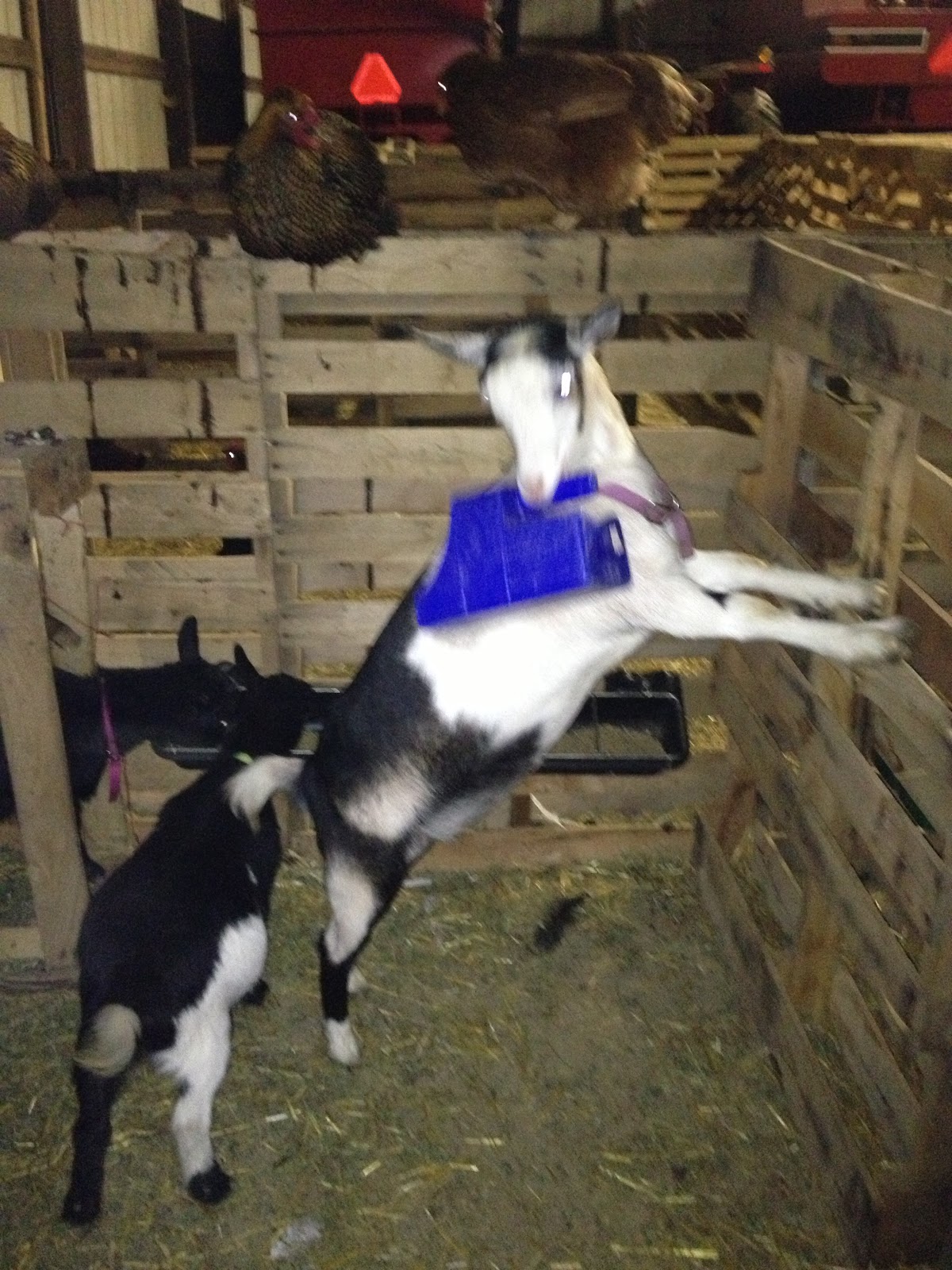
           Baby goats are, next to baby humans, the most unbelievably adorable organisms on the planet and will turn even grown men into a squishy puddle of goo. 

        Large canning projects stop feeling like a fun folksy way to pass an afternoon and start feeling like a Dickensian workhouse at about 11pm (or the 30th quart of peaches.) 

        To mosquitoes, lavender aromatherapy lotion must smell like bacon served with a side of pure bliss.

        What do Beetlejuice and squash bugs have in common? Say their name three times and BOOM, they're all up in your shiz causing problems. 

              And most importantly:

        There is warmth in the coldest day, rest in the hardest labor and blessed quiet amidst the unrelenting chaos. There is beauty in every stone, leaf and twig; a rooster is the best alarm clock and the world becomes even more alive at night. 

         We are so small and our lives are so short; as the saying goes, nothing is guaranteed but death and taxes. We only have one today and no one knows about tomorrow. Chase your dreams as far as it takes to catch them. Regret nothing. 

         Find time to read books under a blanket, walk outside barefoot and feel the sun on your face. Catch frogs and identify trees. Hold a newborn baby in a garden; touch life in its shining best. 

        Vow to like yourself exactly as you are. Eat a meal entirely from scratch. Do it again, and again and again.  Fix things instead of replacing them, and laugh your butt off when it turns out whack. 

        Dirt under your nails, hay in your hair and stinky hobbit feet means it was a good day. 
         
         
*Submitted to the Heritage Homesteaders blog hop, February 2014! 
www.heritagehomesteaders.com


Wednesday, January 2, 2013

A Green Affair: Repost


     (( This entry was originally posted to our family's blog right before our move in November 2011.))


I have a love-hate relationship with seed catalogs. And gardening catalogs.

    And books on organic gardening, and all the other things sprout-related that so thoroughly fascinate and frustrate me.

    When we were still living in our apartment (2006-ish) I requested my first free seed catalog from Burpee's. I'd been interested in gardening for a long time, and figured it would make interesting (albeit futile) reading. I ended up spending 3 hours slowly paging through it, circling all the things I would grow if I only had the space to do it. I held onto it for a long time afterwards, enjoying the occasional leaf-through and chance to rearrange my fantasy mind-garden. In preparation for the move to our first house in early summer 2007, I excitedly packed it... finally, my daydream garden could become a reality!

     After moving in and teaming up with like-minded neighbors, I threw myself headlong into the role of budding homesteader. In spring 2008 we brought home our first feed-store foundlings, six one-week-old pullet chicks (5 black australorp and 1 auracana) and a pair of khaki-campbell ducklings. While the babies rapidly outgrew the plastic recycling bins that served as their makeshift coop we drafted plans for a more permanent space, and started laying out a massive garden on what amounted to over a third of Justin and I's property.

     Too excited to wait, I started seeds in January. By March my kitchen resembled a greenhouse, and before long the sun from our south-facing sliding glass patio door was almost blotted out by an especially ambitious Roma tomato plant that would lean menacingly over anyone sitting at its end of the kitchen table. Swarms of fruit flies started appearing, and my husband spoke wistfully of moving into the garage until he remembered that it too had been taken over by Little Wife on the Prairie's poultry. Ever-supportive as he is (and anxious to reclaim his spot at the table from the tomato tough-guy that had started throwing vines over the curtain rod) he borrowed a gas-powered rototiller and went to work on the massive plot. After an afternoon of labor, the seedlings were ready for their new home.

       We planted. And planted, and planted. And planted. Then we watered, and watched and waited. One little problem became apparent pretty quickly after that... Colorado high-plains soil is about as fertile as the dark side of the moon. My pampered, much-loved plants began to die off in droves. Those that survived started resembling prairie weeds, tall and wiry and defoliated. We rejoiced over the small, tough, sour tomatoes a few of the plants produced and cheered for a single tiny eggplant like it was competing at the Nightshade Olympics. Justin shook his head, bit his tongue and helped out where he could. My small-town Michigan boy knew what they outcome of my little endeavor would be before I'd even started, but it was a lesson I was going to have to learn on my own.

      After losing that poor little eggplant to deer and the rest of the plants to the hard, inhospitable soil I called it a day and put the rest of the plants out of their misery. I spent that winter working on projects with much better outcomes- countless crocheted things, several quilts, our fourth child (and first son) Rikur Scott. The chickens continued to thrive, helping me save face a little bit. I pored over my books, looking for a cut-and-dry answer to what I did wrong.

      In the spring of 2009, I decided to take a different approach. Borrowing the tiller again, we dug up two 4-by-8ft plots and framed them by old landscaping timbers. With my girls playing in the weeds and my baby son in his bug screen equipped carseat I dug out as much of the clay-filled soil as I could, replacing it with bag after bag (after bag) of enriched topsoil. Then we planted, one plot for tomatoes and one for squash. The squash was my first gardening victory, overflowing the plot and spilling zucchini and crooknecks out into the waving prairie grass. The tomatoes didn't fare as well, but I didn't really mind. I was so high on the green-and-yellow mountain of success coming in daily from my squash vines.

     Spring of 2010 rolled around. Our cat had a litter of kittens, who became instant members of the family (even after they found new homes, which we all shed some tears over.)  After reading about container gardening all winter, I decided to add another grow-surface to our property and covered half our porch in pots. Various 'container' tomatoes, herbs, bell peppers and a dwarf jalapeno took up residence as well as two German Queen heirlooms in 'topsy turvy' planters hanging off the railing. I turned the decorative terrace in front of the house into a giant herb garden. The garden plots in the yard once again became home to squash and tomatoes, except I switched them... thinking this application of 'crop rotation' would foil the squash bugs that had started creeping in at the end of the previous season. I sat back and waited to be up to my neck in home-grown nutritious produce. In the end of June, my plants started bearing fruit. And just as I started to pride myself of my success, the fates decided my ego needed to come down a notch or two.


     On July 4th, it hailed. For hours. After those first few telltale pings sounded from above, I raced out with blankets to try to 'tent' my porch garden (sustaining 10+ hailstone hits to my face and back that actually left welts.) When the hail continued, I could only watch as the blankets became weighted down with rain and fell down to the yard below, exposing my precious plants to nature's mutilation. I sat by the door and cried, nauseated at the sight but unable to leave my babies to suffer a horrific death alone. Justin worried aloud about our roof and our vehicles, while I cared only for my plants. Sadie and Ivy drew me pictures of robust, healthy tomato plants in an attempt to cheer me up. When the storm ended I went outside to survey the damage, and found my squash vines literally pitted to death with any zucchini on the vine cored out like canoes. My tomato plants were razed to pathetic green stumps standing 1-2 inches off the ground. I cried some more, decided I was done for the year and turned my attention to our upcoming trip to Michigan.

    I spent hours pulling weeds in my brother-in-law's 1+ acre garden, marveling as he showed me each section and let me and the kids pull up some onions. I braved mosquitoes and heatstroke to wander through their raspberry and blackberry bushes with Rikur strapped to my back in his mei tei, the girls racing through the fields with their cousins and having the time of their lives. Their middle daughter showed me which peach trees had almost-ripe fruit and which apple trees had the most baby apples on them. We watched from the upstairs porch as battles raged, each side plotting to overthrow the group currently in possession of a rope swing hanging from a tree on the hill. My sister-in-law taught me the basics of canning, kick-starting a new obsession. After three weeks, none of us were ready to come home. I missed our house, the dog and cats, my parents and friends. But all the while, leaving was physically painful. Not only because Justin's sister and her husband are definitely kindred spirits, because his family is absolutely awesome and has been great to us from the first time we met them... but because that place just fed something in our souls.

     Every time I've been there, I'm astounded by the total inner tranquility it inspires and endless possibilities. The forests, the mist in the early morning, the beaches on Lake Michigan. The huge rivers, the vines hanging from the trees, lightning bugs at dusk. Seeing my children run barefoot through thick green grass, no fire ants in sight. No more cracked lips and nosebleeds, Sadie's eczema completely gone within three days of our arrival. Cailin's asthma abated. Surrounded with green, with an underlying hum of growth. Of vitality. Of life. Someday, we promised. Someday.

     Cue spring of 2011. Justin went back to school online, working towards his bachelor's degree and opening a whole new possibility of a job in the future that would offer better pay and lower chances of being shot/stabbed/maimed/ect. With Cailin on the verge of teenager-hood and Alarik due to be born in a few short months, we had to confront the reality that our house was growing smaller, it seemed, by the minute.  After much discussion and a lot of sleep lost to thought, we made a decision. We're not getting any younger, our kids are getting more and more rooted here and the time is right financially. If our 'someday' is ever going to come, now is that time.

     Our decision didn't come without cost. We're moving away from my parents, sisters, brother-in-law and niece and nephew. We're leaving a lot of great friends. We're leaving the state the kids and I were born in and have lived our entire lives in. "Bittersweet" just isn't a deep enough word, but neither is "necessary." I worked as a hospice CNA for 2 years, I held so many wrinkled old hands and listened to so many regrets of dreams not pursued and opportunities let pass. As hard as this move is on all of us, I just can't set myself up for what will undoubtedly be the biggest regret of my life if we don't grab this chance and hold on tight. As sad as I am to stretch the distance with so many great people (especially my family) this is just something I have to do. The lifestyle we want for our family, for our children and for our own lives just can't be had here.

       Yesterday, while drinking my requisite two cups of half-caff, I submitted my yearly seed catalog requests with enthusiasm equal to that for my very first Burpee catalog back in 2006... because this year, there's potential. So many daydreams toed up to the very edge of fruition, watching and waiting for their time to shine. 

*Shared to the Heritage Homesteaders blog hop in February 2014!

www.heritagehomesteaders.com

Friday, December 14, 2012

Emotional Self-Reliance (Or, Why It's Important Not To Give A Shit Sometimes)


       I'm a homo sapien. I'm guessing that since you're reading this, you're human as well. According to pretty much any psychologist/psychiatrist/educated person, we have certain basic needs that have to be meet in order to reach our full potential as people in our lifetime. When Abraham Maslow wrote "A Theory of Human Motivation" in 1943, he outlined what became known as Maslow's Hierarchy of Needs.

       Anyone interested in prepping or working towards self-sufficiency is familiar with the first two levels of Maslow's pyramid: the basic human necessities of shelter, food, water, ect. and to be safe from the elements and from harm. Right above that is where things start getting a little more complicated- the necessity of meaningful human interaction. This is where the lone human will run into issues, as they can't provide these resources for themselves as they can the previous ones. They have to reach out to other people and, well... people can be unpredictable and befuddling as hell sometimes.

        Six years ago, I lived in a bubble. A happy, safe little bubble created by the approval and affirmation of a number of people (both friends and family) who I counted among my closest confidantes. I valued their opinions very highly and found personal affirmation in their presence in my life. In my blind, brainless trust of these people I put WAY too high a value on their approval of my life, my family, of my existence. When that naive little bubble shattered into shrapnel, I felt like my heart had been ripped out. I felt betrayed beyond measure and physically sick with grief. The year that followed was such that it is still painful for me to think about.

        When this occurred, the grid was up and running. Our local supermarket was well-stocked and available 24 hours a day, 7 days a week. Gas was expensive but available, we had a roof over our heads and medical professionals a phone call away. While I was coming to grips with my entire support system coming apart at the seams, the world was in the ordinary- this time.

         It took me awhile to see the flaws in my psyche that allowed this caliber of hurt to happen in the first place; I place that blame squarely on putting way too much power in the hands of the people around me. I allowed myself to invest so much in their opinions, their approval. I built my respect for myself as a person through respect from other people, especially those close to me. As a person, I was weak. I had very little love for myself. I tried to build a marvel of architecture on a foundation of sand; I tried to slather layers of fancy frosting onto a dog turd and call it a wedding cake. Despite these people's actions, I really have no one to blame but myself. I might as well have handed them the hypothetical gun that they shot my hypothetical legs off with.

         Little by little, I came to the realization that the monumental shit-pile I was trying so hard to crawl out of was completely preventable. Rather than finding another happy little bubble to wrap my sorry self in, I went on a self-improvement scavenger hunt of sorts. I decided not to look for recognition from people that I couldn't implicitly trust, to find my worth in the places it was actually hiding instead of creating it from relationships that were as authentic as Donald Trump's comb-over. I started seeing the necessity of being more than a little jaded, a little cynical, a little mistrusting. Steeling your emotional self from the elements is just as important as jumper cables in the trunk, bottled water in the basement, or (to some) pallets of MRE's in the bunker. If you're too fragile to withstand an emotional onslaught, what the eff are you going to do if the
zombies are approaching and you just got ordered out of the safehouse for some petty 'difference in opinion?'

       Some people just get off on making the unfortunate folks in their lives miserable. Some have an agenda that needs to be adhered to regardless of who gets squashed in their parade's procession. Some are just toxic people who live toxic lives, and slowly poison the existence of everyone around them. These three can be easy to spot, and any that sneak in under my defenses promptly get the finger and the boot. No room for that bullcrap around here, pardner, so kindly GTFO. BUT...  Sometimes good people do shitty things. People who might not be entirely boot-worthy, who might be bound by blood or other ties that warrant a more democratic approach before they get drop-kicked out of your line of vision. Should they be given free rein to offend again? Not unless you're a masochist. Haul out the post-holer and get ready to mix some concrete, it's fence building time.

        I've watched a few episodes of Dr. Phil. Okay... more than a few. Its a double-X chromosome thing. Something that he's mentioned repeatedly is a concept that I've run across in the past as well- building fences before you build walls. When you build a fence, you're deciding just how much power you're giving that particular person in which to wound you. You keep them at enough of a distance to spare yourself unnecessary hurt should they decide to go twat-waffle on you all over again. Should that person continue to cause unnecessary negativity in your life, the fence needs to go higher. Limit their role in your life even further and strengthen good relationships instead. If things still don't improve, build a wall and move the hell on- there are very few relationships that are really worth the emotional mutilation some people are capable of serving up.

       I've built a lot of fences in my life in the last six years. A few of my fences reach into the proverbial stratosphere, and for good reason. Built a few walls as well; it was never an easy decision to go that route, but for the sake of my sanity and to protect my kids from the pain these people caused us all as a family, I did it. I have no regrets. I've learned to look for Maslow's level 3 from people who have given me reason to really trust them, and stopped looking for my self-affirmation through other people's opinions. Our life on our farm is pretty isolated, and that's as much by choice as it is by location and circumstance; the only person whose opinion I give a rat's ass about anymore if my husband's. Not to say there aren't wonderful people in our lives, because there are: family, friends, the whole cannoli. Not to say I don't care what those individuals think about me at all; of course I do. But none of their opinions are vital to my opinion of myself anymore. A mean-spirited comment from a family member that would've wrecked me six years ago doesn't give me pause now; I roll my eyes and move on. I'm too busy raising kids, wrangling goats and trying to keep my husband's sock drawer stocked to let the negativity have that much real estate in my brain anymore.  Don't like me? that's fine. You're welcome to kiss my butt on your way out.

       Nothing about the homesteading life is easy. The physical demand is daunting all on its own. When you add in the emotional toll of being isolated, busy as hell, the inevitable frustrations and failures, sometimes 'weird' to the city-dwelling folk and possibly 'crazy' in the eyes of your loved ones for pursuing sufficiency in the first place, its your choice how much of an impact those things will have on you. For me, that's no impact anymore. I feel like I've finally built myself up to where the acts of douchebaggery by the people on the other side of my fences have minimal initial impact and none lasting. I'm happy in spite of it. After we moved I let my guard down and put way too much faith in a few people;  I was disoriented, scared, and grieving for what I'd left behind. I blame myself and have erected the appropriate fences. Life has gone on. Forgiveness is great, but forgetting requires a measure of trust in the person who hurt you in the first place. Call me an elephant, because I never forget. That's one mistake I've never made again and never, ever will. You can't expect to really know your own strength until you see it tested, and I'm glad mine got tested when there weren't any mushroom clouds looming in the distance. That strength of character will come in handy if the proverbial shit ever does hit the fan.

       The Jones' can keep up with themselves. The gossip mill can turn, the soap opera can play itself out without my name in the credits. I've moved on from all of it. I don't need any of it. I'm perfectly happy living like an island, letting a few trusted landlubbers canoe out and visit every now and then. I rebuilt myself to last, and I'm grateful to the people behind my fences (and even the ones behind the walls) for pushing me off the cliff and forcing me to find out what true peace feels like. I cherish it, because I cried a river and bled an ocean to find it.

                                               Thumb- Thanks You For Hating Me (1998)


Monday, November 12, 2012

Homesteading: Why, how and the bumpy road we drove here on

          You don't have to be born into a 'farming family' to become a farmer. Really.


           Small towns everywhere seem to have their eminent 'farming families.'  But the number of family farms has plummeted from 6.8 million in 1935 to 2.1 million in 2002, according to a U.S Dept. of Agriculture census. This RealTruth article paints a frightening picture of the rapidly disappearing concept of the family-owned farm, citing urban sprawl, the economy and the prevalence of 'Big Ag' as some of the reasons for its demise. http://realtruth.org/articles/100607-006-family.html The title of 'farmer' has also become synonymous with poverty, odor and lack of intelligence to a lot of people (who also seem to think the food they eat grows in the grocer's freezer in its cardboard packaging) and also carries some of the blame, in my opinion. Who would want to become a farmer and struggle against the Monsanto Machine to make a buck when you could become a high-powered CEO and drive a Maserati? if any sort of small-scale farming is going to continue in this country, this mindset needs to take a sharp left turn off of the wagon and keep on rolling down the proverbial hill. Like, yesterday. If those CEO's looked far enough back in their family tree, they'd see that they come from a 'farming family' too. We all do. Each and every one of us has ancestors who lived a self-sustaining lifestyle, because that was how they stayed alive. There's nothing wrong with wanting to find those roots, regardless of whatever wayward turn those branches have taken in the last century. It's in all of our blood in some degree, and for those of us wanting to return to that lifestyle, our 'lack of roots' shouldn't be a roadblock to getting there.

           When we first became interested in hobby farming, we were newlyweds living in an apartment in a suburb of Denver, CO. My child from a previous relationship had been joined by a baby sister 11 months after our marriage, and we were expecting our third daughter. Aware that the new baby's arrival would put us over the apartment complex's occupancy limit, we started looking into buying a house. We looked at some local areas, but became more and more interested in surrounding rural communities. When Ivy was 5 months old we bought our first home; a 7-year old bi-level ranch home in Elizabeth, CO. We were still in a subdivision, but our property bordered on open space and the noise level was a fraction of what we'd dealt with at our apartment. Our first spring there we bought 6 chicks and 2 little ducklings from one of the local feed stores. They rapidly outgrew the plastic recycling tubs they were living in, requiring a coop be built with haste. The first tiny egg we found in a nest was cause for celebration; the kids often took it out of the fridge to admire and we couldn't bring ourselves to eat it for over 2 weeks. Our first foray into farming (on a very small scale) had borne fruit, and we couldn't have been prouder if we'd laid that little egg ourselves.

             Our flock grew over the next few years, as did our desire to expand on this newly-found love of sustainability (meek as it was.) But as we got more interested in other ways to feed ourselves sans grocery store, the limitations of our property became more and more apparent. The rock-hard clay soil of eastern Colorado struggled to produce a single tomato per vine, until locusts descended in biblical proportions and ate everything green right down to the inhospitable dirt. Our water source came from a privately-owned community well that frequently lost pressure, leaving us without water for a day or more at a time and costing us over $100 a month for extremely modest usage. Storms often knocked the power out. This fostered a dual interest in prepping and survivalism, as we were frequently left without access to utilities. We debated putting in a woodstove, but that did nothing for the water situation (the county prohibited 'extra' wells in our area) or the crappy soil. On April 6th of 2011, we decided to stop talking about a sustainable lifestyle and start working towards actually doing it.

             On December 6th, 2011 we locked the door of our old house for the last time and started the frozen drive east to southwest Michigan. Justin had accepted a job and our house was ready to go on the market once the paint and carpet guys finished with it. We lived with relatives until June of this year, when we moved into our new home on a 'short term rent-to-own' sort of arrangement. Our house in CO closed in August, after a nightmarish 8 months on the market that included an offer that fell through, carbon monoxide scares, a screaming fire alarm that had the neighbors peeking in windows while preparing to call 911 and an incredibly expensive bunch of work that had to be done to bring the septic up to code. We moved our flock of chickens, small herd of 5 miniature dairy goats and flock of ravenous turkeys into our new place and got to work learning the ropes. We're now in the process of closing on the new place. We don't ever intend to move again.

Every day is another lesson. We're learning as we go, making plenty of mistakes in the process. We thought we could use leftover chicken wire to fence in the goats' pastures until we could afford something better; we ended up with half the landscaping eaten and frequent visits from the herd on the front porch of the house. We gave the turkeys access to the barn and ended up plagued by flies. We installed woven wire fencing and penned the gobblers in their own pasture with a Quonset hut. We still get discouraged at times, but we're fixing things as they come up. We're learning. Neither of us were born into 'farming families' but we're determined to raise our children in one. The future is so uncertain; we want our kids growing up with the knowledge they need to feed, clothe and house themselves should they ever need to.

Anyone with an interest in hobby farming or self- sustainability, don't let your roots (or lack thereof) deter you. If you're willing to invest the money to make the transition and the time to learn the skills, you can make it happen. There's an incredible wealth of resources available to teach and inspire:

  *Books. Some of our favorites are:
-The Encyclopedia of Country Living by Carla Emery
-The Self-Reliant Homestead by Charles A. Sanders
-The Back-to-Basics Handbook by Abigail R. Gehring
-The Joy of Keeping Farm Animals by Laura Childs
-The Backyard Homestead edited by Carleen Madigan
-The Self-Sufficient Life and How To Live It by John Seymour.
Some great like-themed books that we found inspiring are:
- Animal, Vegetable, Miracle by Barbara Kingsolver
- The Unhealthy Truth by Robyn O'Brien
-Food Rebels, Guerrilla Gardeners and Smart-Cookin' Mamas: Fighting Back in an Age of Industrial Agriculture by Mark Winne.
-Anything by Joel Salatin or Michael Pollan. A current fav of mine is Folks, This Ain't Natural by Joel Salatin; informative, inspirational, downright hilarious.

 *Magazines. (Most of these are available in paperless online or Kindle editions if that's your thing)
-Hobby Farms. Great info on small-scale agriculture including equipment reviews, articles comparing livestock breeds, gardening, Q & A sections and ads in the back that are actually interesting to read!
-Hobby Farms Home. Tons of recipes (including canning and cast-iron cooking) green kitchen remodels, seasonal food resources and homestead crafts.
-Mother Earth News. One of the first and still one of the best! lots of good info about sustainable agriculture, composting, DIY projects and global issues that affect anyone who appreciates food and oxygen
-Backyard Poultry. Geared more towards suburban and urban poultry enthusiasts but still some good info for farm folk as well. Articles about poultry health and happiness, 'coop improvement' projects and lots of diversified breed info.
-Backwoods Home Magazine. Another of the firsts, also still one of the best. Off-grid transition and living info, firearms articles, recipes, Q&A with the awesome Jackie Clay, gardening info, supply stockpiling tips and more.

*Documentaries. Netflix Instant is truly awesome, not only for finding random old movies we liked as kids to turn on for our littles during rainy afternoons when SpongeBob is driving us insane. TONS of great documentaries are available to download online or to stream through any gaming console with internet capability. Some of our favorites are:
-Food, Inc. Nauseating but life-changing!
-Fresh. Joel Salatin of Polyface Farms and Will Allen of Growing Power in one documentary. Enough said.
-Natural World: A Farm for the Future.  A filmmaker transitioning her family's 5-acre hobby farm to run without fossil fuels of any kind
-Mad City Chickens. Stories from backyard chicken keepers, a feed store owner who rescues a foundling bird who narrowly escaped becoming a McNugget and an incredibly interesting segment on Murray McMurray , our favorite hatchery.

*Tha Interwebz. Websites, message boards, blogs (ha) you name it it's out there. I recently heard through the goat-person grapevine about the 'pooch test,' which can supposedly tell you if a goat is bred relatively early. One entry in the Google search engine, and I spent over and hour in the barn  (on my butt in the straw while Fiona the goat tried to eat my hair) comparing the hundred-plus Google image results to my various doe goat's lady parts. I guess its safe to say I appreciate this resource more than my goats do.

*Podcasts. We like Jack Spiriko's The Survival Podcast (TSP) and In The Rabbit Hole, both of which have great homesteading info as well as prepping-related stuff. If anyone knows of any good farming podcasts, please comment and let me know! I need to something new to listen to while driving to the feed store.

*Old-timers, 'farmin' folk' and pretty much anyone over 60. Some of the most invaluable advice we've been given has come from people who have been in agriculture for a long, long LONG time. We've been pleasantly surprised with just how open, insightful and encouraging the old-timers we've had the good fortune of meeting have been. The 70's back-to-the-land movement is shockingly similar to the current interest in 20 and 30-something urbanites deciding to keep their mohawks and go farm instead of covering up their ink and looking for an office job; find the parallels to your situation and search out some like-minded people a generation or two ahead. I've learned a ton from our 'hay guy' Frank about hay composition, different cuttings and their availability at different times of the year, and which hay would optimize (or decrease) our doe goats' milk quality once they start birthin' babies and so on. Approach the conversation in a respectful, non-egotistical way and you'll walk away with some great firsthand knowledge.

*Take the plunge and get your hands dirty. Make those mistakes, figure out solutions and grow your own special brand of smarts. Hopefully you'll catch onto things a little quicker than we did, and won't end up with goats trying to eat your porch or learning how to hijack the feed scoops.